
WATERLOW : ecological, economic, and sustainable root irrigation system The Nano-irrigation of trees
General presentation
Waterlow is an irrigation system mounted on the drip irrigation network and placed in contact with the roots. It is an ecological system that is sustainable over time (more than 15 years), easy and quick to install. Compared to conventional surface drip irrigation, WaterLow offers water savings ranging from 70% to 90% depending on the soil type. It also offers savings in pumping energy (70%-80%), savings in liquid fertilizer (70%-80%), savings in labor for weeding, and in root pesticides in case of disease. Its interest is primordial in preserving soils against salinization and fighting against waterlogging of soils in oases and the rise of water tables, which threaten the productivity of palm groves. Waterlow is a system that is sustainable over time, whose primary advantage is its resistance to clogging and root obstruction.
TECHNICAL SHEET
WATERLOW is a system composed of an injector and a connection system to the surface irrigation network.
- A) The injector
It is formed by a LDPE (low-density polyethylene) tube with a diameter of 16mm and a length of 50 cm. This tube is multi-perforated at its distal end, which is sealed by a watertight polypropylene cap. This distal end, which will be in contact with the roots, is surrounded by a granular layer containing natural and inert mineral elements enclosed in a TNT (non-woven polypropylene) pouch, which is non-toxic and slow to biodegrade. The role of the granular layer is to protect the injector orifices against clogging by soil particles and, above all, against obliteration by roots. The injector pouch is 8 cm high by 7 cm in diameter.
The surface end of the tube is sealed by a watertight polypropylene cap. An air intake is placed at the top of the tube just below the edge of the cap to allow for air oxygenation inside the tube and the reduction of temperature during heatwaves and in arid and Saharan zones.
- B) The connection system
It allows the injector to be connected to the surface irrigation network. This system includes a 4.5/6 mm irrigation micro-tube, 25 cm long, connected at one of its ends to the injector tube by means of a 5mm connector. The connection zone is located 20 cm from the distal end for injectors intended for fruit trees and 30 cm for date palms. These distances actually correspond to the underground insertion depth of the Waterlow injector. The second end is connected to a long drip emitter of the Key Klip LMB type, with a flow rate of 4L/H for fruit trees and 8L/H for date palms. The drip emitter is punched directly into the surface irrigation tubes. The water will flow at a fixed rate through the drip emitter into the micro-tube, and then into the injection tube which will deliver it directly to the root zone.
ADVANTAGES
- WATER SAVINGS
Savings in irrigation water compared to the conventional drip system: This comparative study was based on the study of the water volume required to reach a certain soil depth and on the volume of the moistened soil bulb in the Waterlow system and the surface drip system respectively.
Hygrometric sensors were used and placed at depths of 50 cm and 60 cm.
It shows that the Waterlow system offers water savings of 70 to 75% in clay-limestone soil and 80 to 90% in sandy soil depending on the ambient temperature.
- SAVINGS IN LIQUID FERTILIZER
The multi-functional underground sensors allowed us to study the volume of liquid fertilizer required to reach the root layer with the Waterlow system and the surface drip system respectively. It shows that Waterlow offers fertilizer savings ranging from 70% to 80% depending on the soil type.
- SAVINGS IN PUMPING ENERGY
Comparative studies between the Waterlow system and the conventional drip system have demonstrated that savings in pumping energy are close to 80% during the hot summer season.
- SAVINGS IN ROOT PESTICIDE
In case of disease, the savings in root pesticide are equivalent to those of liquid fertilizers.
- SAVINGS IN LABOR
Root irrigation makes it possible to avoid the growth of weeds that require labor for weeding. Furthermore, Waterlow is installed on irrigation networks whose pressure is maintained thanks to low-flow drip emitters. Thus, it is possible to irrigate more than 100 or 200 trees at the same time depending on the power of the water pump. This advantage is very important in palm tree irrigation, making it possible to reduce the cost of labor required to open and close irrigation valves by sector, bearing in mind that submersion irrigation is still common practice in Tunisian oases.
- DISEASE PREVENTION
Root irrigation makes it possible to avoid excessive surface moisture and weeds, which can be the cause of frequent fungal diseases and harmful insects.
In the case of palm trees, Waterlow keeps the trunk area dry, which gives it resistance against parasites and especially attacks by pests.
- PREVENTION OF SOIL SALINIZATION
Subsurface irrigation avoids evaporation losses but also avoids salt deposits in the case of surface irrigation with saline water. Thus, the Waterlow system prevents the progressive salinization of soils, the consequence of which is a decrease in tree profitability.
- PROMOTES DEEP ROOTING OF TREES
Waterlow provides moistened soil bulbs in the form of wet soil cylinders that will be progressively colonized by the roots (root hydrotropism). The cylinders have heights varying from 50 cm to 1 meter depending on the quantity of irrigated water and the soil type.
This is how Waterlow guides the root system toward the depths, thus allowing better resistance of the trees against winds and bad weather.
- EASY AND QUICK TO INSTALL
A simple thermal auger allows digging holes 20 cm deep (30 cm for palm trees) to place the injectors. The average installation time for a Waterlow injector is 30 seconds.
- DURABILITY AND RESISTANCE
Waterlow is designed with materials that can last more than 15 years. Its conceptual technology protects it against root obstruction and clogging. Waterlow thus represents the most resistant and durable root irrigation system in the world.
- LOW COST
The Waterlow system is the cheapest in the world and the best adapted to arid and desert regions. It represents the irrigation system best suited to intensive and semi-intensive arboriculture.
- INSTALLATION
The installation is easy and quick. The use of a thermal auger facilitates the creation of a 20 or 30 cm hole in which the Waterlow injector will be housed. The average time required to install an injector is 30 seconds.
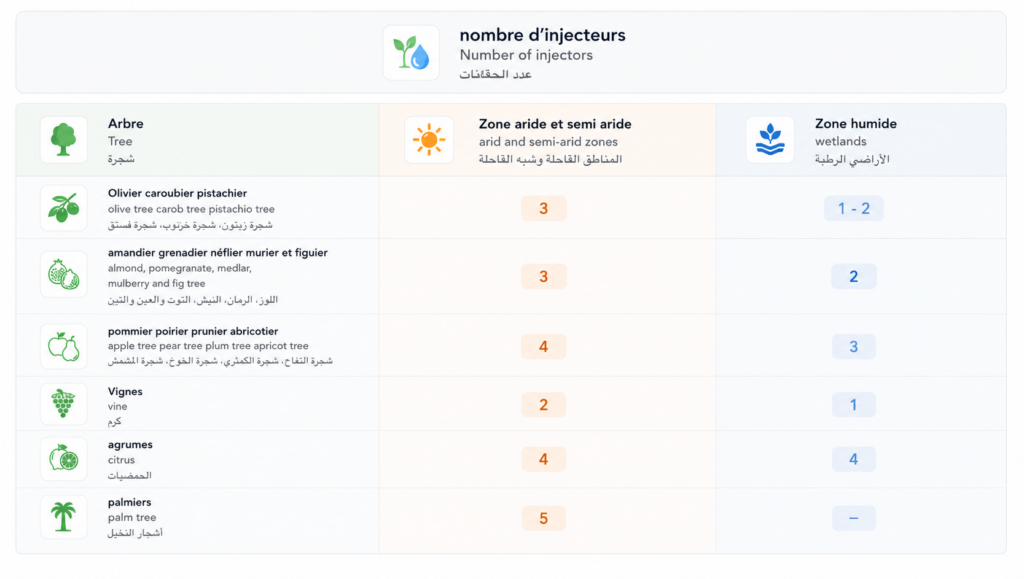
A- Number of injectors
B- Depth of injectors
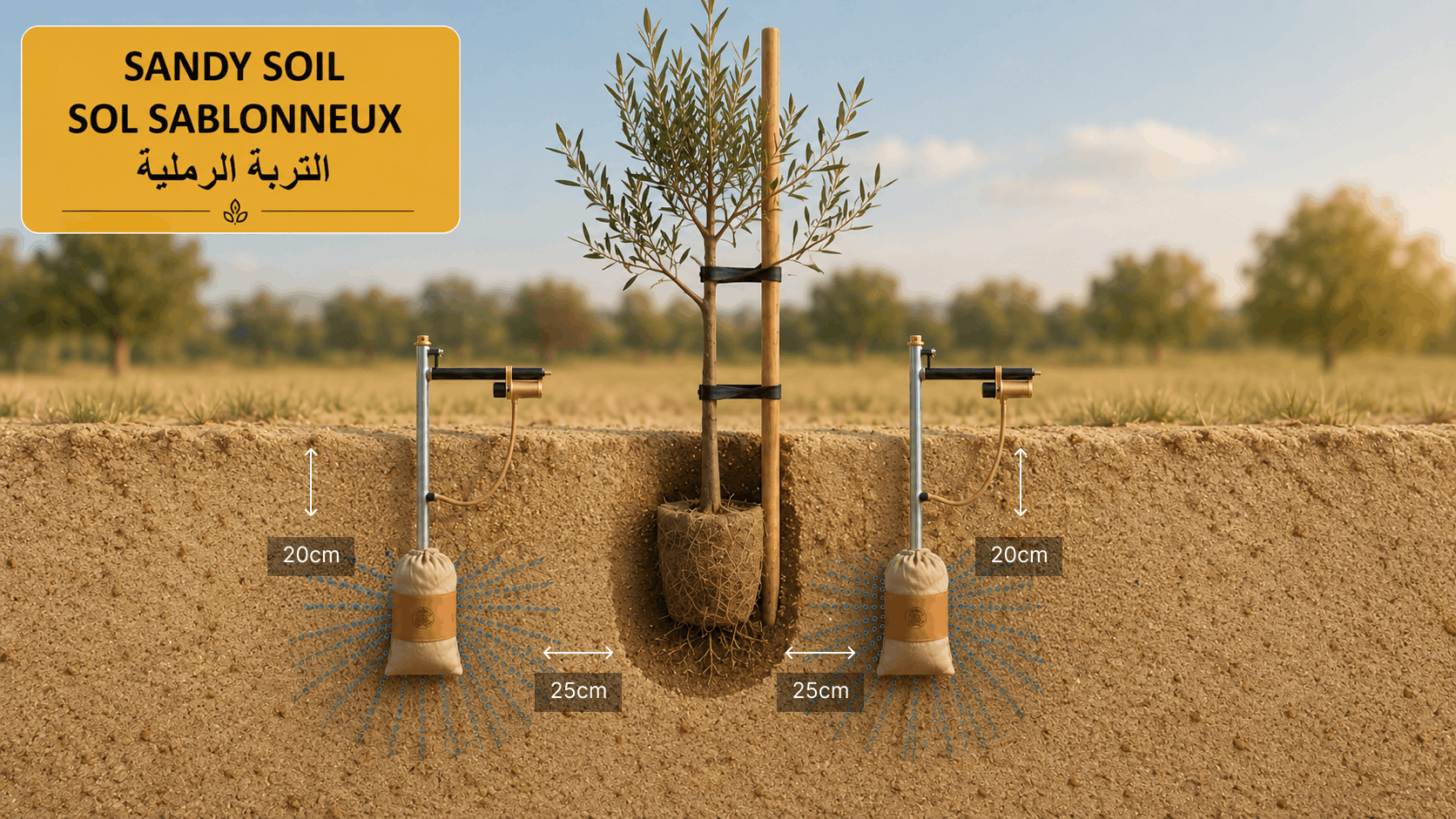
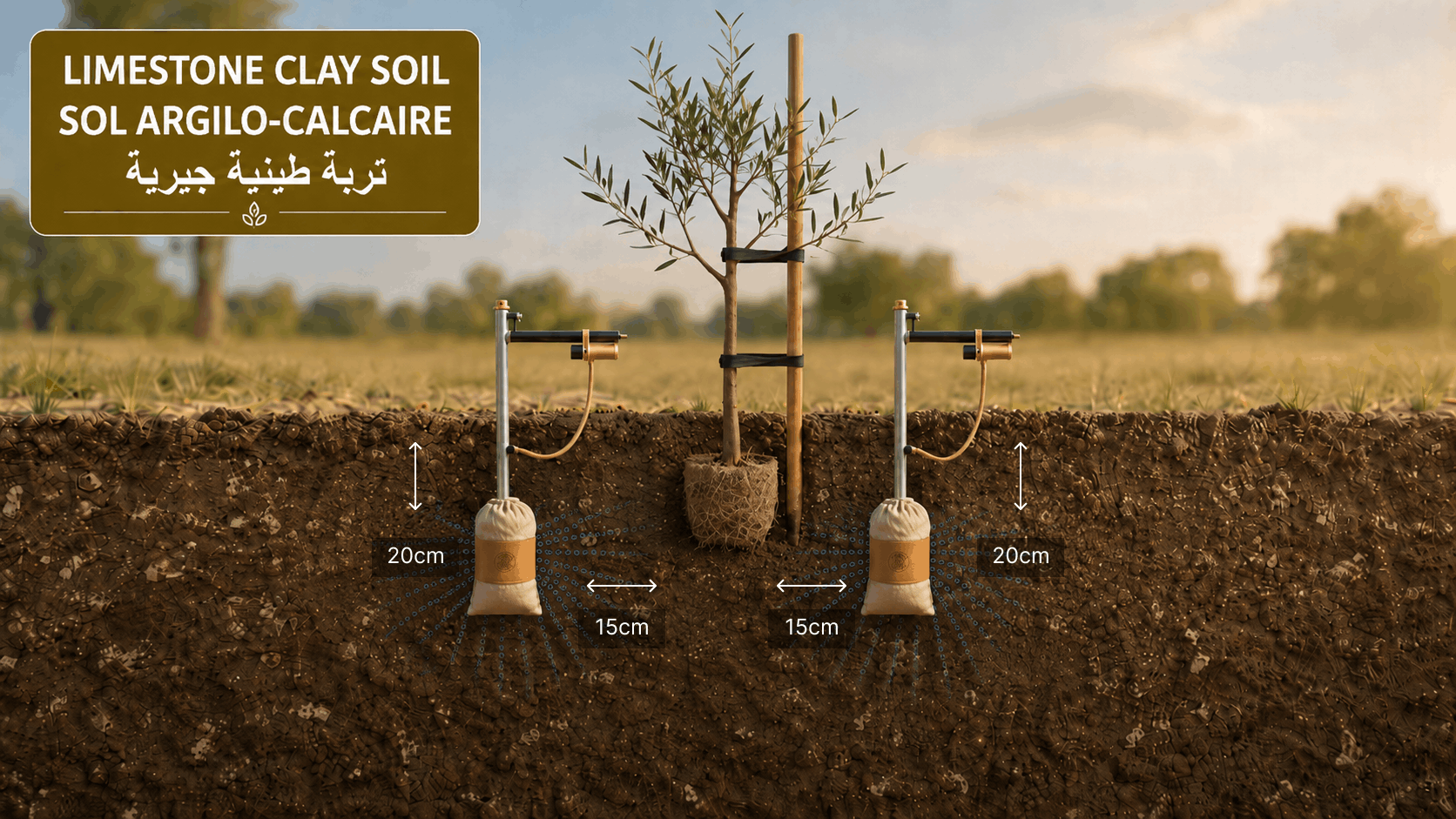
The injectors are housed underground at a depth of 20 cm for fruit trees of all kinds. This depth is 30 cm for palm trees planted in the ground for 6 months and more.
C- Distance of the injectors relative to the tree
a) Young seedlings to be planted
The injectors are only used for fruit tree seedlings older than 6 months (ideally 1 year or more) with a soil root ball whose diameter is at least 25 cm. In sandy soil, the injectors are placed 20 cm from the soil root ball, and in clay-limestone soil, 15 cm from the soil root ball.
For young date palm seedlings, the injectors are only installed after 6 months in the ground with surface irrigation during this period.
A) Adult tree already planted for more than one year
The injectors are placed 40 cm from the tree trunk. This distance is 60 cm for palm trees.
Maintenance There is no special maintenance for the Waterlow system. For farmers who do not have particulate filters in their irrigation networks, it is advisable to check the drip emitter filter once a year and, if necessary, to wash it and put it back in place. Our choice of the Key Klip drip emitter is guided by a low risk of emitter obstruction and by the possibility of cleaning the filter easily.
SMART CONTROLLED IRRIGATION
The Waterlow system is coupled with an underground hygrometric sensor technology allowing to guide the quantity of irrigated water and the frequency of irrigations. This technology also offers possibilities for remote irrigation by means of controlling irrigation pumps and/or solenoid valves. This technology can even offer a self-regulated smart irrigation (fully autonomous), thus offering significant gains in time, water, energy, and labor.
EXPERTISE
The Waterlow system has been trialed since April 2023 on 2,500 fruit trees, essentially olive trees and carob trees. In 2024, Waterlow was installed for vines, fig trees, almond trees, mulberry trees, medlar trees, citrus fruits, and pomegranate trees with very good results. In May 2025, the challenge was root irrigation of date palms. With a perspective of more than a year and a full production cycle of the date palm, we can affirm that Waterlow represents the system of choice for palm tree irrigation, ensuring significant water savings and preserving oases against subsurface waterlogging and soil salinization.